


요꼬가와는 1915년 창립이래 계측, 제어, 정보기술을 축으로
최첨단의 제품을 산업계에 제공함으로써 사회 발전에 공헌해오고 있습니다.
제품기초지식
OTDR를 이용한 양방향(투웨이) 광섬유 측정 이해

 OTDR를 이용한 양방향(투웨이) 광섬유 측정 이해.pdf (269.7 KB)
오늘날처럼 서로 연결된 세상에서 안정적인 디지털 통신은 필수적입니다. 24시간 내내 끊김 없는 연결을 보장하기 위해 서비스 제공업체와 네트워크 운영자는 방대한 광섬유 네트워크를 유지 관리할 책임이 있습니다. 그러나 이러한 네트워크는 신호 손실이나 광섬유 단선과 같은 문제에 직면하여 통신이 중단될 수 있습니다. Optical Time Domain Reflectometers(OTDR)는 이러한 문제를 신속하고 정확하게 식별하고 해결하는 데 중요한 역할을 합니다.
양방향 광섬유 OTDR 측정의 이점
양방향 OTDR 테스트는 다음과 같은 이유로 광섬유 케이블에 대한 종합적인 평가를 제공합니다.
- 숨겨진 문제 탐지 : 각 방향의 다양한 특성으로 인해 접합부 또는 커넥터 문제와 같은 숨겨진 문제가 발생할 수 있습니다. 양방향 테스트를 통해 정확한 평가를 수행할 수 있습니다.
- 네트워크 무결성 검증 : 양방향 측정값을 비교하여 네트워크 무결성을 확인하고, 단방향 테스트에서 놓쳤던 비대칭적인 문제를 밝혀냅니다.
- 고장 위치 파악 능력 향상 : 양방향 테스트를 통해 더 많은 데이터 포인트를 확보하여 고장 지점을 더 빠르게 찾아내고 유지보수 시간을 단축할 수 있습니다.
- 커넥터 및 스플라이스 성능 평가 : 양방향 테스트는 양방향 성능을 평가하여 신호 품질과 네트워크 안정성을 보장합니다.
- 표준 준수 : 양방향 OTDR 테스트는 TIA-455-231, IEC 61300-3-35, GR-196-CORE 및 ITU-T G.650.3과 같은 산업 표준을 참조합니다. 이러한 표준은 광섬유 네트워크에 대한 철저한 평가 및 검증을 보장하기 위해 일관되고 정확한 테스트 방법론에 대한 지침을 제공합니다.
양방향 테스트 시나리오 예시:
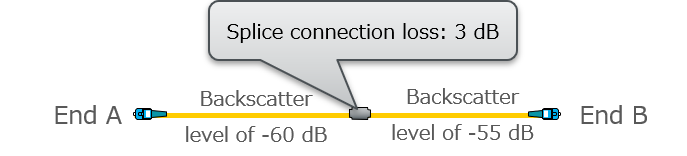
광섬유에 빛을 주입하면 빛의 일부는 광섬유 내부에서 산란되어 빛의 경로 반대쪽 끝으로 이동합니다. 이를 후방 산란광이라고 합니다. 각 광섬유는 고유한 후방 산란광 값 또는 레벨을 가지고 있습니다. 후방 산란 레벨이 다른 광섬유의 연결 손실은 측정 방향에 따라 달라지므로 정확한 손실 평가를 위해서는 양쪽 끝에서 모두 측정해야 합니다.
예를 들어, 후방 산란 레벨이 -60dB인 광섬유를 -55dB인 광섬유에 연결하면 손실은 3dB가 됩니다.
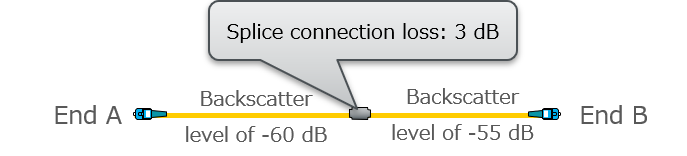
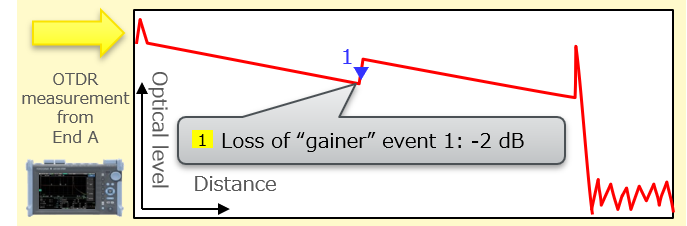
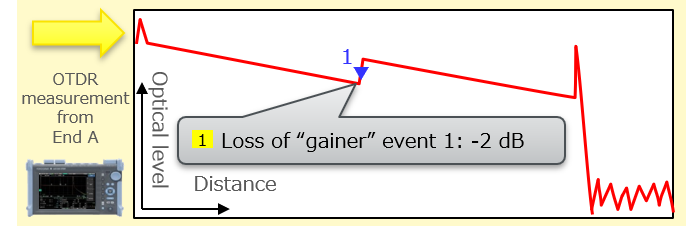
광 시간 영역 반사계(OTDR)로 A측에서 측정할 때, 빛은 -60dB의 후방 산란 레벨로 진행하다가 연결 지점에서 3dB 감소합니다. 하지만 연결 지점을 지나 B측의 후방 산란 레벨은 -55dB로 A측보다 5dB 높기 때문에, 연결 손실과 B측의 후방 산란 레벨 차이로 인해 후방 산란 레벨이 2dB로 표시됩니다. 이벤트 1의 손실은 -2dB이므로 빛이 증폭된 것처럼 보입니다. 이러한 현상을 아래 그림과 같이 "게이너(gainer)"라고도 합니다. 
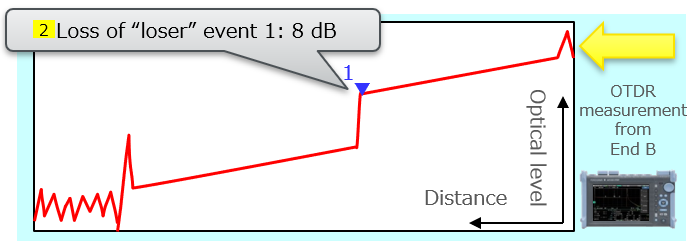
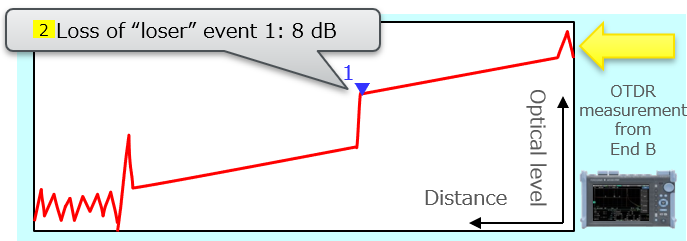
반면, OTDR이 B단에서 측정할 때, 빛은 -55dB의 후방 산란 레벨로 이동하며 연결 지점에서 3dB 감소합니다. 그러나 연결 지점 이후의 후방 산란 레벨은 -60dB이므로 빛은 추가로 5dB 감소합니다. 따라서 총 8dB 감소합니다. 이벤트 1의 손실은 실제로 8dB로 표시됩니다. 이와 반대로, 이러한 유형의 이벤트는 아래 캡션에서와 같이 "손실(loser)"이라고도 합니다.
정확한 손실액은 다음 항목들의 평균값입니다.
A단에서 측정한 "게이너" 이벤트 1의 손실: -2dB
End B에서 측정한 "패자" 이벤트 1의 손실: 8dB
따라서 정확한 손실 은 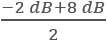 3dB입니다.
양쪽 끝에서 측정한 값을 평균하여 광섬유의 후방 산란 값을 빼고 이벤트 1의 손실을 보정합니다. AQ7280 및 AQ1210의 양방향 측정 분석은 [고급 분석] → [양방향 추적] 에서 수행할 수 있습니다 .
양방향 OTDR 테스트는 광섬유 케이블에 대한 종합적인 평가에 필수적이며, 네트워크 무결성, 오류 위치 파악 및 전반적인 성능에 대한 통찰력을 제공하여 궁극적으로 통신 네트워크의 신뢰성과 효율성을 보장합니다.
나에게 맞는 OTDR을 찾으세요.
현장용 OTDR을 선택할 때는 기본 사양과 가격 외에도 여러 요소를 고려해야 합니다. 다기능성, 사용자 편의성, 장기적인 지원과 같은 기능은 현장 작업의 효율성과 사용 편의성을 크게 향상시킬 수 있습니다. 또한, 장기적으로 정확하고 신뢰할 수 있는 결과를 얻으려면 장비의 품질과 신뢰성을 최우선으로 고려해야 합니다.
요꼬가와는 수십 년간의 현장 경험과 혁신을 바탕으로 견고하고 신뢰할 수 있는 OTDR을 제공하는 것으로 명성이 높으며, 믿을 수 있는 선택입니다. 열악한 현장 환경에서도 정확한 측정값을 제공하는 장비를 생산해 온 요꼬가와의 실적은 품질과 고객 만족에 대한 헌신을 입증합니다. 요꼬가와와 같이 신뢰할 수 있고 오랜 역사를 자랑하는 브랜드를 선택하면 OTDR 투자에 대한 신뢰성과 성능에 대한 확신을 얻을 수 있습니다.
휴대용 OTDR은 현장 환경에서 광섬유 네트워크를 테스트하고 문제 해결하는 데 사용되는 휴대용 장치입니다. 일반적으로 크기가 크고 실험실용으로 설계된 탁상형 OTDR과 달리 휴대용 OTDR은 소형, 경량이며 열악한 환경을 견딜 수 있도록 견고하게 제작되었습니다. 내구성 있는 설계 외에도 에너지 효율성과 오래 지속되는 배터리는 하루 종일 중단 없이 현장에서 사용하기 위해 매우 중요합니다.
OTDR의 작동 원리는 무엇인가요?
Optical Time Domain Reflectometers(OTDR)는 광섬유에 짧은 레이저 펄스를 방출하여 빛이 이동하면서 산란되고 반사되는 빛을 측정합니다. 이 데이터를 분석하여 단선, 굽힘, 커넥터 손실과 같은 문제를 식별하고 위치를 파악합니다. 결과는 그래프로 표시되어 기술자가 광섬유 네트워크의 문제 해결 및 유지 관리를 지원합니다.
휴대용 OTDR을 선택할 때 어떤 특징을 고려해야 할까요?
휴대용 OTDR을 선택할 때는 측정 범위, 동적 범위, 해상도, 휴대성, 배터리 수명, 사용 편의성, 연결성, 소프트웨어 기능, 내구성, 가격 및 지원과 같은 요소를 고려해야 합니다. 정확하고 효율적인 광섬유 테스트를 위해 특정 현장 테스트 또는 OSP(외부 설비) 요구 사항에 맞는 기능을 우선적으로 고려하십시오.
In today's interconnected world, reliable digital communication is essential. To ensure seamless connectivity 24/7, service providers and network operators shoulder the responsibility of maintaining vast fiber optic networks. However, these networks face challenges such as signal losses and fiber breaks, which can disrupt communication. Optical Time Domain Reflectometers (OTDRs) play a crucial role in identifying and resolving these issues swiftly and accurately.
Benefits of Two-Way Fiber Optic OTDR Measurement
Bi-directional OTDR testing provides a comprehensive assessment of fiber optic cables for the following reasons:
- Detecting Hidden Issues: Varied characteristics in each direction may hide problems like splice or connector issues. Bi-directional testing ensures accurate assessment.
- Verification of Network Integrity: Comparing measurements from both directions confirms network integrity, revealing asymmetrical issues missed in single-direction testing.
- Improving Fault Localization: Testing in both directions provides more data points, speeding up fault pinpointing and reducing maintenance downtime.
- Assessing Connector and Splice Performance: Bi-directional testing evaluates performance in both directions, ensuring signal quality and network reliability.
- Compliance with Standards: Bi-directional OTDR testing is referenced in industry standards such as TIA-455-231, IEC 61300-3-35, GR-196-CORE, and ITU-T G.650.3. These standards provide guidelines for consistent and accurate testing methodologies to ensure thorough assessment and validation of fiber optic networks.
Example Bi-Directional Test Scenario
When light is injected into an optical fiber, some of it is scattered within the optical fiber to the opposite end of the light‘s path. This is called backscattered light. Each optical fiber has its own backscattered light value, or level. Since the connection loss for fibers with different backscatter levels varies according to the measurement direction, correct loss assessment requires measurement from both ends.
For Example, a fiber whose backscatter level is -60 dB is connected to a fiber of -55 dB at a loss of 3 dB
When an Optical Time Domain Reflectometer (OTDR) measures from End A, the light travels at a backscatter level of -60 dB and then declines by 3 dB at the connection point.However, since the backscatter level beyond the connection point is -55 dB, which is higher than the A side by 5 dB, the backscatter level is displayed as 2 dB due to the difference between the connection loss and the backscatter level of the B side. The loss of event 1 is -2 dB, which looks like the light is amplified. This type of event is also referred to as a “gainer” as shown below at caption 
On the other hand, when the OTDR measures from End B, the light travels at a backscatter level of -55 dB and declines by 3 dB at the connection point. However, since the backscatter level beyond the connection point is -60 dB, the light declines by an additional 5 dB. It therefore declines 8 dB in total. The loss of event 1 is displayed, in fact, as 8 dB. Conversely this type of event is also referred to be a “loser” as shown below at caption
The correct loss value is the average of the following:
The loss of “gainer” event 1 measured from End A: -2 dB
The loss of “loser” event 1 measured from End B: 8 dB
Therefore, the correct loss =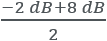 = 3 dB
By averaging the values measured from both ends, the backscatter value of the fibers is deducted and the loss of event 1 is corrected. Analysis of two-way measurement in the AQ7280 and AQ1210 is [Advanced Analysis] → [2-Way Trace].
Two-way or bi-directional OTDR testing is essential for a comprehensive evaluation of fiber optic cables, providing insights into network integrity, fault localization, and overall performance, ultimately ensuring the reliability and efficiency of communication networks.
Find the OTDR That's Right For You
When selecting an OTDR for field use, it's essential to consider factors beyond just basic specifications and cost. Features like multitasking capabilities, user-friendliness, and long-term support can greatly enhance efficiency and ease of use during field operations. Additionally, prioritizing the quality and reliability of the instrument is crucial to ensure accurate and dependable results over the long term.
Yokogawa's reputation for providing robust and reliable OTDRs, backed by decades of experience and innovation in the field, makes them a reputable choice. Their track record for producing instruments capable of withstanding harsh field conditions and delivering accurate measurements is a testament to their commitment to quality and customer satisfaction. Choosing a trusted and established brand like Yokogawa can provide peace of mind and confidence in the reliability and performance of the OTDR investment.
A portable OTDR (Optical Time Domain Reflectometer) is a handheld device used for testing and troubleshooting fiber optic networks in field environments. Unlike benchtop OTDRs, which are typically larger and designed for laboratory use, portable OTDRs are compact, lightweight, and ruggedly built to withstand harsh conditions. Besides their durable design, energy efficiency, and a long lasting battery is often critical to ensure uninterrupted field use throughout the day.
What are the Working Principles or an OTDR?
An Optical Time-Domain Reflectometer (OTDR) emits short laser pulses into an optical fiber, measuring backscattered and reflected light as it travels. By analyzing this data, it identifies and locates issues such as breaks, bends, and connector losses. The results are presented graphically, aiding technicians in troubleshooting and maintaining optical fiber networks..
What characteristics to look for in a portable OTDR?
When choosing a portable OTDR consider factors like measurement range, dynamic range, resolution, portability, battery life, ease of use, connectivity, software features, durability, and price/support. Prioritize features that suit your specific field testing or OSP (Outside Plant) requirements for accurate and efficient fiber optic testing.
하단영역

한국요꼬가와전기(주)
사업자등록번호 102-81-17301
경기도 용인시 기흥구 기흥로 58-1 기흥 ICT밸리 SK V1 A동 407호 ~ 411호 (우) 16976 (분당선 기흥역 2번 출구 500m)
T&M 영업본부 : 02-2628-3813
서비스팀 :02-2628-3872
팩스 : 02-2628-3899
COPYRIGHT ⓒ 2024 YOKOGAWA ELECTRIC CORPORATION. ALL RIGHTS RESERVED.